Local SEO for Dentists in Texas, Florida & California: How to Win Your City’s Map Pack
Local SEO for dentists in Houston, Dallas, Miami, Tampa, Los Angeles, San Diego and more: rank in Google’s map pack, earn reviews safely, book more patients.

- Google says local results are based mainly on relevance, distance and popularity, and that no one can pay for a better local ranking.
- In sprawling metros like Houston, Dallas–Fort Worth and Los Angeles, you compete neighborhood by neighborhood, not citywide.
- Reviews help only when earned legitimately. Incentives and “happy-patients-only” requests break Google’s rules.
- Each state adds its own rules: Florida requires a disclaimer on free-exam ads, Texas extends medical privacy law, and California practices face website-tracking claims.
In Houston, Miami or Los Angeles, a patient searching “dentist near me” sees three practices on a map before anything else. In large, competitive metros, that map pack decides which phones ring. This guide explains how Google chooses those three practices, what to fix first, and what changes in the biggest markets in Texas, Florida and California.
Every policy statement below comes from Google’s published guidelines, U.S. Department of Health and Human Services (HHS) records or state law, linked at the end.
How Local SEO Works for Dental Practices
What is local SEO for dentists?
Local SEO is the work of making your practice appear when nearby patients search for dental care on Google Search, Google Maps and AI assistants. It rests on four things: your Google Business Profile, your reviews, your website’s location and treatment pages, and consistent practice information across the web.
It’s the highest-intent traffic a practice can earn. Someone searching “emergency dentist open now” isn’t researching — they’re choosing.
How does Google decide which dentists appear in the map pack?
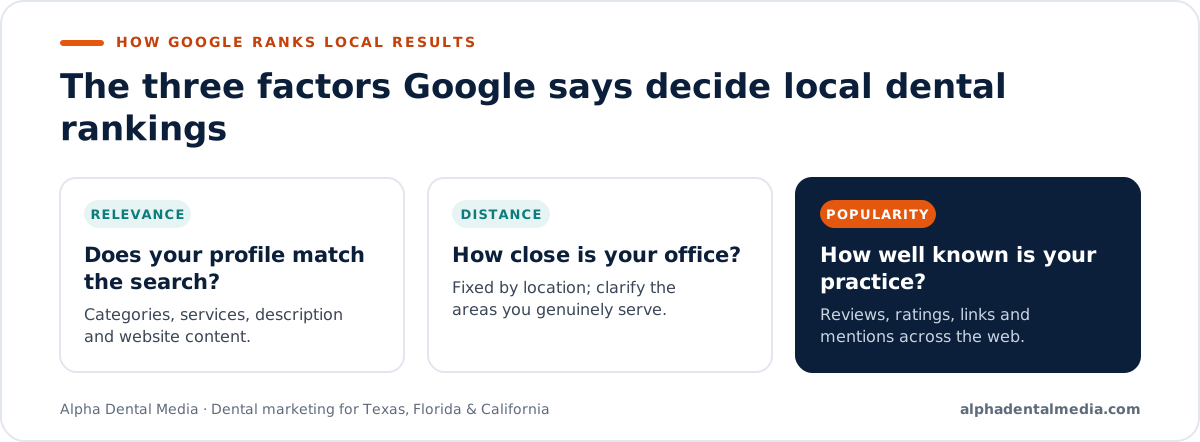
Google says local results are based mainly on relevance, distance and popularity. Relevance is how well your profile matches the search; distance is how far you are from the searcher; popularity reflects how well known your practice is, including reviews and ratings.
| Factor | What Google measures | What you control |
|---|---|---|
| Relevance | How well your profile matches the search | Categories, services, description, website content |
| Distance | How far you are from the searcher or the area they named | Little; location pages clarify the areas you serve |
| Popularity | How well known you are, including reviews and web mentions | Reviews, citations, local links, a strong website |
Google also states that complete, accurate profiles are more likely to appear, and that more reviews and positive ratings can help local ranking.
Can a dental practice pay Google for a higher map ranking?
No. Google states there is no way to request or pay for a better local ranking. Google Ads and Local Services Ads can buy labeled sponsored placements, but they don’t change your organic map position.
Be wary of any vendor that guarantees a top-three map position. Google’s own documentation contradicts that promise.
The Foundation Every Practice Needs First
What should a dentist’s Google Business Profile include?
Complete every relevant field: your exact business name, address, phone, website, hours (including holidays), the most specific primary category, every service you offer, booking link, attributes such as languages spoken, and real photos of your office and team.
- Primary category: the most specific accurate choice (“Dentist,” “Pediatric dentist,” “Orthodontist”).
- Services: list each treatment with a plain-language description.
- Languages: in bilingual markets, list the languages your team actually speaks.
- Photos: exterior, entrance, reception, operatories and team, refreshed regularly.
See our Google Business Profile service for a full optimization checklist.
Can I add keywords or my city to my practice name on Google?
No. Your profile name must match your real-world signage. Google does not allow unnecessary information such as keywords, cities or taglines in the business name. “Bayou Family Dental” is fine; “Bayou Family Dental – Best Houston Implant Dentist” risks suspension.
Can I offer patients a discount for leaving a Google review?
No. Google prohibits offering payment, discounts or free services in exchange for reviews, and prohibits asking only satisfied patients for reviews (review gating). Ask every patient consistently and make leaving a review easy.
Google also bars asking staff to collect a set number of reviews, and reviews from current or former employees.
How should dentists reply to negative reviews without violating HIPAA?
Reply briefly and professionally without confirming the person is a patient or mentioning any treatment detail, then invite them to call the office. HHS has settled with dental practices for disclosing patient information in review replies, including a $23,000 settlement with a California practice in 2022.
A safe template: “Thank you for your feedback. We take every concern seriously and would welcome the chance to talk directly. Please call our office manager at [phone].”
Local SEO for Dentists in Texas
How do dentists rank in Houston, Dallas–Fort Worth, San Antonio and Austin?
Texas metros are geographically huge, so distance limits how far any single office can rank. Winning in Texas means dominating the neighborhoods closest to your office, building a dedicated page for each area you genuinely serve, and earning steady reviews that mention your location and treatments.
- Houston: a vast metro of distinct communities — Katy, Sugar Land, The Woodlands, Pearland and more. Optimize for the communities near your office, not “Houston” as a whole. Spanish- and Vietnamese-speaking patients are a significant audience; bilingual pages and listed languages help.
- Dallas–Fort Worth: two core cities plus fast-growing suburbs like Plano, Frisco and Arlington. Each suburb behaves like its own market, so each location you serve deserves a unique page.
- San Antonio: a large Hispanic community makes Spanish-language content and bilingual front-desk staff a genuine competitive advantage.
- Austin: rapid growth into Round Rock, Cedar Park and Pflugerville means newer neighborhoods often have fewer established practices — an opening for practices nearby.
Do Texas dentists have privacy rules beyond HIPAA?
Yes. Texas’s medical records privacy law, commonly called HB 300, adds state requirements on top of HIPAA, including employee privacy training. Review requests, reply templates and website forms should be checked against both.
Local SEO for Dentists in Florida
How do dentists rank in Miami, Tampa, Orlando and Jacksonville?
Florida markets differ sharply: Miami is multilingual and dense, Tampa and Orlando include seasonal and visiting populations, and Jacksonville covers a very large land area. Match your languages, hours and location pages to who actually searches near your office.
- Miami: many patients search in Spanish. A Spanish version of key treatment pages, bilingual reviews and listed languages strengthen relevance.
- Tampa–St. Petersburg: seasonal residents mean winter demand shifts; keep hours accurate and highlight new-patient availability.
- Orlando: visitors searching for urgent care create emergency-dentist demand. If you take same-day emergencies, say so clearly in your profile and on your site.
- Jacksonville: one of the largest U.S. cities by land area, so distance matters more than usual. Target the neighborhoods you can realistically serve.
What do Florida dentists need to know about advertising a free exam?
Florida law requires ads offering a free, discounted or reduced-fee service, exam or treatment to include a specific statement that patients may refuse to pay for other services performed within 72 hours of responding to the ad. That includes “free consultation” offers on landing pages and in Google Ads.
Review every promotional page and ad with that rule in mind before launch.
Local SEO for Dentists in California
How do dentists rank in Los Angeles, San Diego, the Bay Area and Sacramento?
California’s major metros are among the most competitive dental markets in the country. Success comes from hyperlocal focus — specific neighborhoods rather than whole cities — multilingual content where your team serves those communities, and treatment pages strong enough to outrank established competitors.
- Los Angeles: neighborhoods like Koreatown, Pasadena, Santa Monica and the Valley act as separate markets. Multilingual pages (Spanish, Korean, Chinese, Armenian and others) can open audiences competitors ignore.
- San Diego: a large military community and strong neighborhood identities (Chula Vista, La Jolla, North County) reward location-specific pages and clear insurance information.
- San Francisco Bay Area and San Jose: high competition and dense listings; detailed treatment pages and review recency often separate the top three.
- Sacramento: growth in Elk Grove, Roseville and Folsom creates opportunities in suburbs with fewer established practices.
Why do California dentists need to audit website tracking?
The California Dental Association has warned that dentists are receiving demand letters claiming website cookies and tracking pixels violate California privacy law. Audit your tracking tools, remove nonessential pixels, keep your privacy policy accurate, and consult an attorney if you receive a letter.
Major-Metro Priorities at a Glance
| Metro | Local search dynamic | First priority |
|---|---|---|
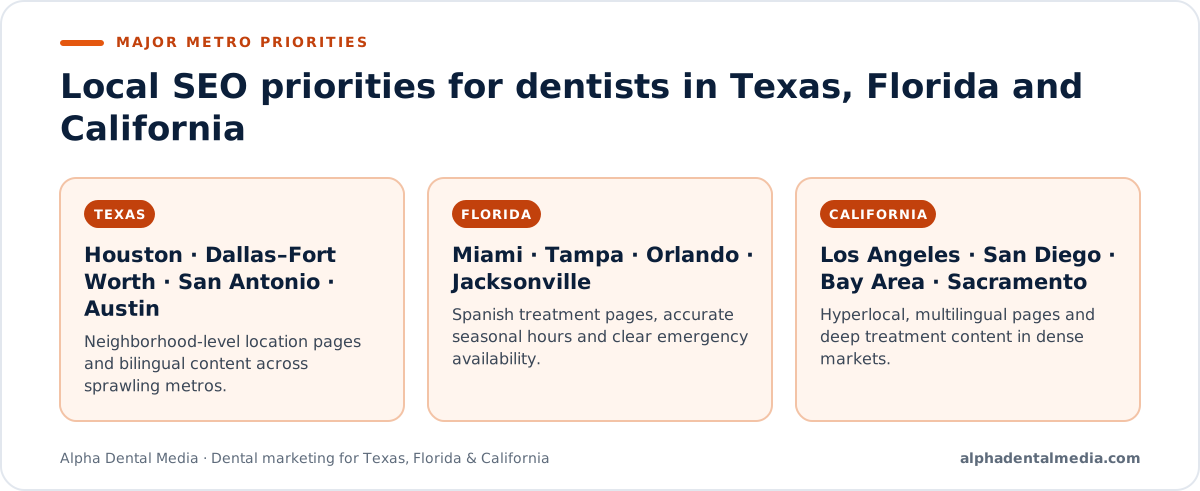
| Houston | Huge area, distinct communities | Community-level location pages |
| Dallas–Fort Worth | Many independent suburbs | One unique page per suburb you serve |
| San Antonio | Large Spanish-speaking audience | Bilingual content and listed languages |
| Austin | Fast-growing new neighborhoods | Early visibility in newer suburbs |
| Miami | Multilingual, dense competition | Spanish treatment pages and reviews |
| Tampa / Orlando | Seasonal and visitor demand | Accurate hours, emergency availability |
| Jacksonville | Very large land area | Realistic service-area targeting |
| Los Angeles | Neighborhoods act as markets | Hyperlocal and multilingual pages |
| San Diego | Strong neighborhood identity | Neighborhood pages, insurance clarity |
| Bay Area / Sacramento | High competition, growing suburbs | Treatment-page depth, review recency |
What Results to Expect and When
How long does local SEO take for a dental practice?
Profile corrections can show within days to weeks, but stable map-pack gains in large, competitive metros usually take several months of consistent work. Timelines depend on your starting point, your competitors and how steadily reviews and content are added.
| Phase | Timeframe | Focus | What to watch |
|---|---|---|---|
| Foundation | Weeks 1–2 | Profile, categories, hours, name/address/phone consistency, call tracking | Edits held for review |
| Build-out | Weeks 3–6 | Services, photos, location and treatment pages | Profile calls and direction requests |
| Reputation | Months 2–3 | Compliant review requests, HIPAA-safe replies | Steady recent reviews |
| Authority | Months 3–6 | Citations, local links, supporting content | Visibility across more neighborhoods |
| Growth | Month 6+ | New treatments and neighborhoods | New-patient calls from local search |
Troubleshooting Ranking Problems
Why did my dental practice disappear from Google Maps?
The usual causes are a profile suspension, a duplicate listing, an unverified address change or a flagged name or category edit. Sign in to your profile, check for warnings, and search Maps for duplicate listings of your office.
If suspended, don’t create a new profile. Fix what breaks Google’s guidelines and submit a reinstatement request.
Why does a practice farther away outrank mine?
Distance is only one factor. A farther practice can outrank you with a more relevant profile or stronger popularity signals — more recent reviews, better categories or dedicated treatment pages. Compare your profile side by side with theirs to find the gap.
We moved offices. How do we keep our rankings?
Update the address in your existing profile instead of creating a new one; Google may ask you to re-verify. Update your website, schema markup and directory listings at the same time so old and new addresses don’t conflict.
The Bottom Line
Local SEO rewards practices that are accurate, active and genuinely helpful. Get your Google Business Profile right, ask every patient for reviews within the rules, build location pages that say something real, and adapt to the neighborhoods, languages and laws of your market. Practices that do these basics consistently tend to win the map pack over time.
Sources
- Google Business Profile Help — How to improve your local ranking on Google
- Google Business Profile Help — Guidelines for representing your business
- Google Maps — Prohibited and restricted content
- U.S. HHS Office for Civil Rights — Resolution agreement: New Vision Dental
- Florida Statutes — §456.062, Advertisement of free or discounted services
- HIPAA Journal — Texas HB 300 requirements
- California Dental Association — Dentists urged to analyze website tracking functions
Disclaimer: This article is for general educational purposes only and is not legal, regulatory or HIPAA compliance advice. Search guidelines and state laws change, and local results vary by market, competition and each practice’s circumstances; no ranking or outcome is guaranteed. Consult a qualified healthcare attorney or compliance professional about HIPAA and state law, and a qualified dental marketing professional before changing your Google Business Profile, advertising or website.