How to Write Dental Treatment Pages That Rank and Convert (Implants, Invisalign, Veneers)
How to structure dental treatment pages for implants, Invisalign and veneers that rank in Google and AI search and turn visitors into consultations.

- One dedicated page per priority procedure, written for patients, outperforms a single “services” page.
- Lead with a direct answer, then cover candidacy, process, cost, comfort, recovery and credentials.
- Clinical review and named authors support the expertise Google expects for health topics.
- Claims, offers and “specialist” language must follow state dental board advertising rules.
Treatment pages are where research turns into appointments. A patient comparing implant options, aligner brands or veneer costs is closer to booking than almost any other visitor — yet many dental websites give these procedures two paragraphs of template copy and a stock photo.
This guide lays out the structure we use for treatment pages that rank in Google and AI search and convert visitors into consultations, with the advertising rules that matter for practices in Texas, Florida and California.
Why Treatment Pages Matter
Why does each dental treatment need its own page?
Because patients search for specific procedures, and a dedicated page can answer every question about that procedure in depth. One “services” page listing twenty treatments can’t fully match searches like “all-on-4 cost” or “Invisalign for adults,” so it rarely ranks or converts for them.
Prioritize pages for:
- Procedures with the highest production value (implants, full-arch, aligners, veneers)
- Urgent needs that convert quickly (emergency care, toothache, broken tooth)
- Services that differentiate you (sedation, same-day crowns, specific technology)
What makes a treatment page rank in Google and AI search?
Completeness, clarity and trust. Pages that answer patient questions directly, explain the topic in depth, show who wrote and reviewed them, and stay technically accessible are what Google’s helpful-content guidance rewards — and what AI features can cite.
The Treatment Page Template
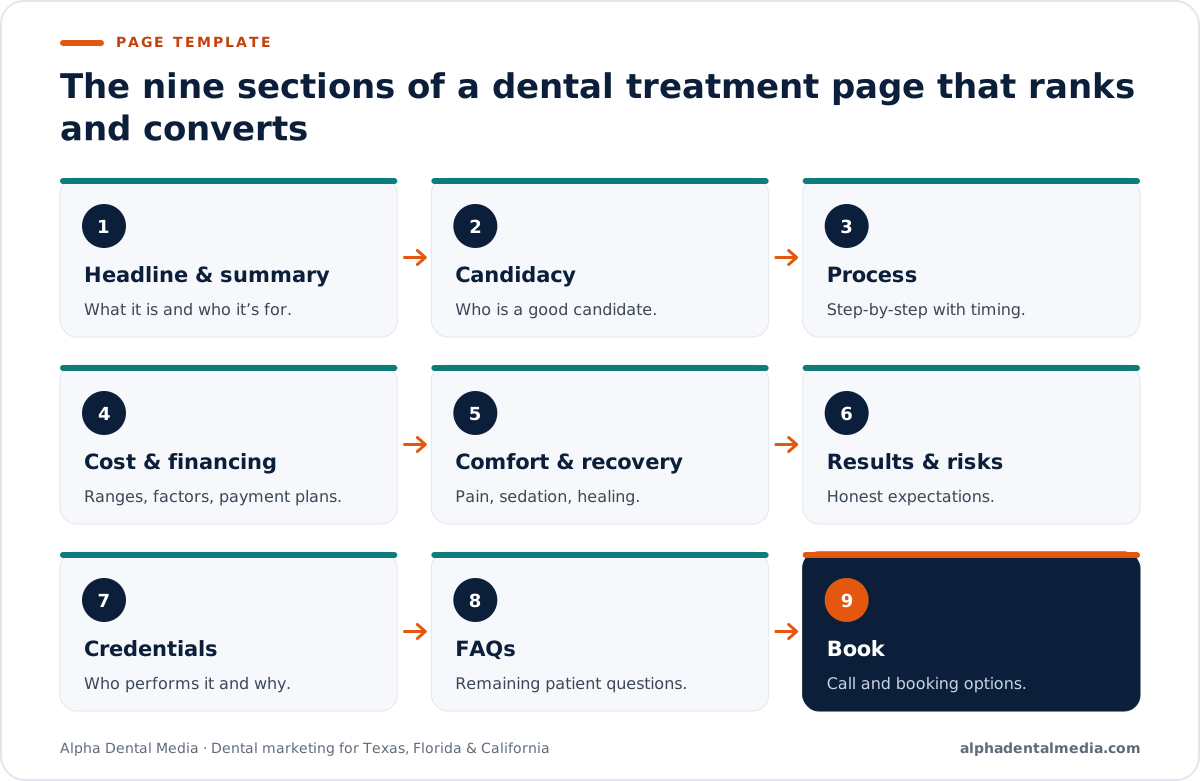
What sections should a dental treatment page include?
A strong treatment page includes a clear headline, a direct summary answer, candidacy, the step-by-step process, cost and financing, comfort and recovery, results and risks, provider credentials, patient questions, and an easy way to book.
| Section | What it answers | Conversion role |
|---|---|---|
| Headline and summary | What is this and is it for me? | Confirms relevance immediately |
| Candidacy | Who is a good candidate? | Pre-qualifies patients |
| Process | What happens, step by step? | Reduces fear of the unknown |
| Cost and financing | How much, and can I pay over time? | Removes the biggest objection |
| Comfort and recovery | Will it hurt? How long to heal? | Addresses anxiety |
| Results and risks | What to realistically expect | Builds trust through honesty |
| Provider credentials | Why this practice? | Differentiates you |
| FAQs | Remaining questions | Captures long-tail and AI queries |
| Booking CTA | How do I start? | Turns research into a consultation |
How should a dental treatment page open?
With a specific headline and a two-to-three-sentence answer to the main question — what the treatment is, who it helps and how to get started. Place call and booking buttons beside it so ready patients don’t have to scroll.
Example opening for an implant page:
“Dental implants replace missing teeth with a titanium post and a natural-looking crown. Most healthy adults with enough jawbone are candidates, and treatment typically takes a few months from consultation to final crown. Book a consultation to find out which option fits your needs and budget.”
Should dental treatment pages show prices?
Showing honest ranges or starting points, with clear explanations of what changes the cost, builds trust and pre-qualifies patients. If you can’t publish ranges, explain the cost factors and financing options and invite a consultation for an exact quote.
How long should a dental treatment page be?
Long enough to answer the questions patients actually ask, and no longer. A focused page for a complex procedure such as implants often needs substantially more depth than a page for a simple service. Use headings, tables and short paragraphs so it stays scannable.
Trust, Accuracy and Compliance
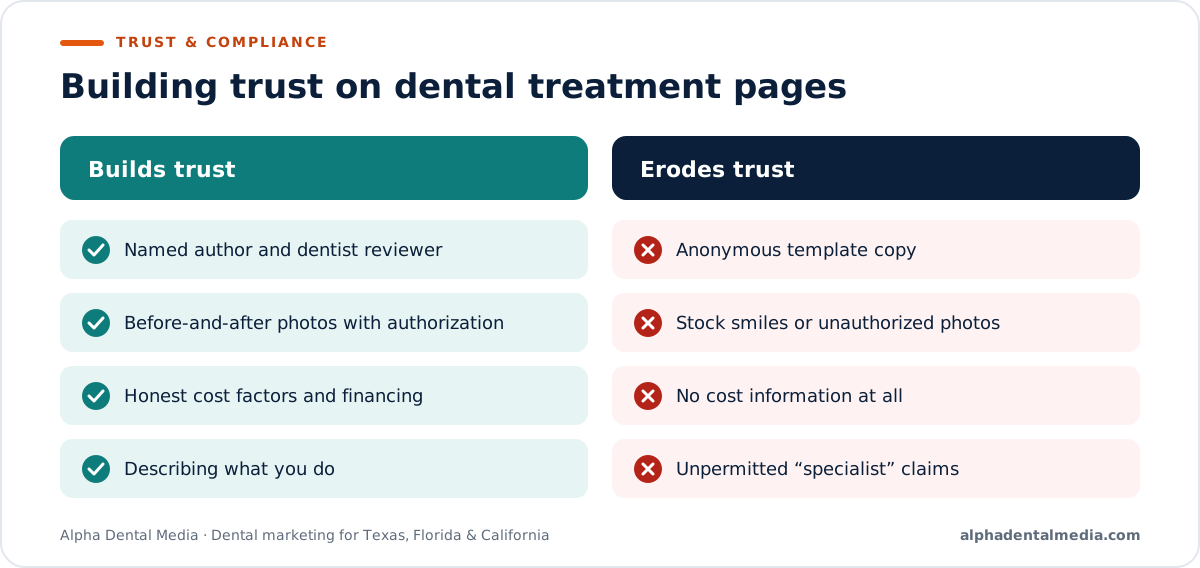
Who should write and review dental treatment content?
A writer experienced in dental topics can draft it, but a licensed dentist should review it for clinical accuracy. Show the author and clinical reviewer with credentials, and update pages when techniques, materials or guidance change.
- Named author with relevant experience
- Dentist reviewer with credentials and review date
- Claims supported by evidence or clinical consensus
- Real before-and-after photos only with written authorization
- Risks and alternatives explained honestly
Can a general dentist call themselves an implant or cosmetic “specialist”?
Be careful. State dental boards restrict how dentists may advertise specialties, and “specialist” language is often limited to recognized specialties and qualified practitioners. Describe what you do (“we place and restore dental implants”) rather than claiming a specialty unless your board permits it.
What structured data should a treatment page use?
Use FAQPage markup for genuine question-and-answer sections, BreadcrumbList for navigation, and connect the page to your Dentist location and provider Person markup. Structured data should always match what’s visible on the page.
Treatment Pages in Texas, Florida and California
How should treatment pages adapt to major metros?
Match the language, neighborhoods and questions of the patients you serve. In bilingual markets, publish Spanish versions of top treatment pages; in sprawling metros, add location context and directions; in high-cost markets, explain financing clearly.
| Market | Treatment-page priority |
|---|---|
| Houston, Dallas–Fort Worth | Office locations and nearby communities on each page |
| San Antonio, Miami, Los Angeles | Spanish versions of implant, aligner and emergency pages |
| Orlando, Tampa | Emergency and same-day care details, if offered |
| Bay Area, San Diego, Sacramento | Transparent financing and provider credentials |
Do state advertising rules affect treatment page offers?
Yes. Treatment pages that promote offers are advertising. Florida requires a specific disclaimer on ads offering free or discounted exams or services, and every state board regulates claims and specialty language. Review offers and claims before publishing.
Writing Each Section Well
How should the cost section of a treatment page be written?
Explain what drives the cost, give honest ranges or starting points if you can, describe insurance and financing options, and invite a consultation for an exact quote. Patients trust practices that are transparent about cost far more than those that avoid the topic.
Cost factors to explain for implants, for example:
- Number of implants and type of restoration
- Need for extractions or bone grafting
- Imaging and planning
- Sedation options
- Insurance coverage and financing plans
How should the process section be structured?
Use numbered steps from first consultation to final result, with approximate timing for each stage. Patients worry most about the unknown, so a clear sequence reduces anxiety and makes booking the first step feel easy.
| Step | Example for clear aligners |
|---|---|
| 1. Consultation | Exam, photos and digital scan |
| 2. Treatment plan | Preview of tooth movement and timeline |
| 3. Aligners delivered | Fit check and wear instructions |
| 4. Progress visits | Periodic check-ins and new trays |
| 5. Retention | Retainers to keep results |
What photos and visuals should a treatment page include?
Use real photos of your office, team and technology, and before-and-after images only with written patient authorization. Diagrams that explain the procedure help patients understand it. Give every image descriptive alt text and a caption that adds context.
How should treatment pages link to the rest of the website?
Link each treatment page to related services, the provider bios of dentists who perform it, financing information, relevant blog posts and the booking page. Link blog posts back to the treatment page so authority flows to the pages that convert.
- Links to the dentists who provide the treatment
- Links to financing and insurance information
- Links from related blog posts
- Links to related treatments (e.g., implants and dentures)
- Booking and call options repeated through the page
What are the most common treatment page mistakes?
Thin template copy, no cost information, stock photos, no named author or reviewer, exaggerated claims, missing booking options and copying the same content across location pages. Each weakens rankings, trust or conversions.
Should treatment pages include videos?
Short videos of a dentist explaining a procedure, or a walk-through of the technology involved, can build trust and keep patients on the page. Add a text summary or transcript so the information is accessible and understandable to search engines, and make sure videos don’t slow the page.
Should each office have its own treatment pages?
Usually not. Duplicating the same treatment content across location pages creates near-identical pages that compete with each other. Keep one strong page per treatment and mention which offices provide it, then make each location page unique with local details.
If a procedure is only offered at certain offices, say so clearly on the treatment page and link to those locations.
How often should treatment pages be updated?
Review priority treatment pages at least once or twice a year, and whenever your technology, pricing, financing options or clinical approach changes. Update the review date when a dentist re-checks the content, so patients and search engines can see it’s current.
How should treatment pages handle comparison questions?
Patients often compare options — implants vs. bridges, aligners vs. braces, veneers vs. bonding. A balanced comparison section that explains pros, cons, cost differences and suitability builds trust and matches the questions patients ask Google and AI assistants.
| Comparison | What patients want to know |
|---|---|
| Implants vs. bridges | Longevity, cost over time, effect on neighboring teeth |
| Clear aligners vs. braces | Visibility, comfort, treatment time, suitability |
| Veneers vs. bonding | Durability, cost, how much tooth is changed |
| Dentures vs. implant-retained dentures | Stability, eating, upkeep, cost |
Keep comparisons honest: when another option may suit some patients better, say so. Practices that explain trade-offs clearly tend to earn more trust than pages that present one treatment as the answer for everyone.
What to Expect
How long until a new treatment page ranks?
New or rewritten pages are often indexed within days to weeks, but competitive procedure keywords can take several months to reach top positions. Track impressions, rankings and — most importantly — consultation requests from each page.
| Phase | Timeframe | Focus |
|---|---|---|
| Research | Week 1 | Patient questions, competitor pages, keywords |
| Draft and review | Weeks 2–3 | Writing, clinical review, photos with authorization |
| Publish | Week 4 | Schema, internal links, indexing request |
| Improve | Months 2–6 | Update based on rankings and inquiries |
The Bottom Line
Treatment pages win when they answer every question a patient has before they call — candidacy, process, cost, comfort, risks and who will treat them — in a clear, honest and clinically reviewed way. Build one strong page per priority procedure, keep it current, and measure the consultations it produces. Start with the two or three procedures that matter most to your production, publish them well, and expand from there. A handful of excellent treatment pages, linked from your blog, provider bios and location pages, will usually outperform a long list of thin ones — in Google, in AI answers and, most importantly, in booked appointments.
Sources
- Google Search Central — Creating helpful, reliable, people-first content
- Google Search Central — AI features and your website
- Google Search Central — Introduction to structured data
- Florida Statutes — §456.062, Advertisement of free or discounted services
- U.S. HHS — Uses and disclosures for marketing (HIPAA)
Disclaimer: This article is for general educational purposes and is not legal, clinical or regulatory advice. Treatment details, costs and suitability vary for each patient, and search results vary by market; no outcome is guaranteed. Have clinical content reviewed by a licensed dentist and advertising claims reviewed against your state dental board’s rules by qualified counsel.