Google Business Profile Categories for Dentists, Explained (Primary vs Secondary)
Which Google Business Profile categories dentists should choose, primary vs secondary, common mistakes, and how categories affect map rankings.

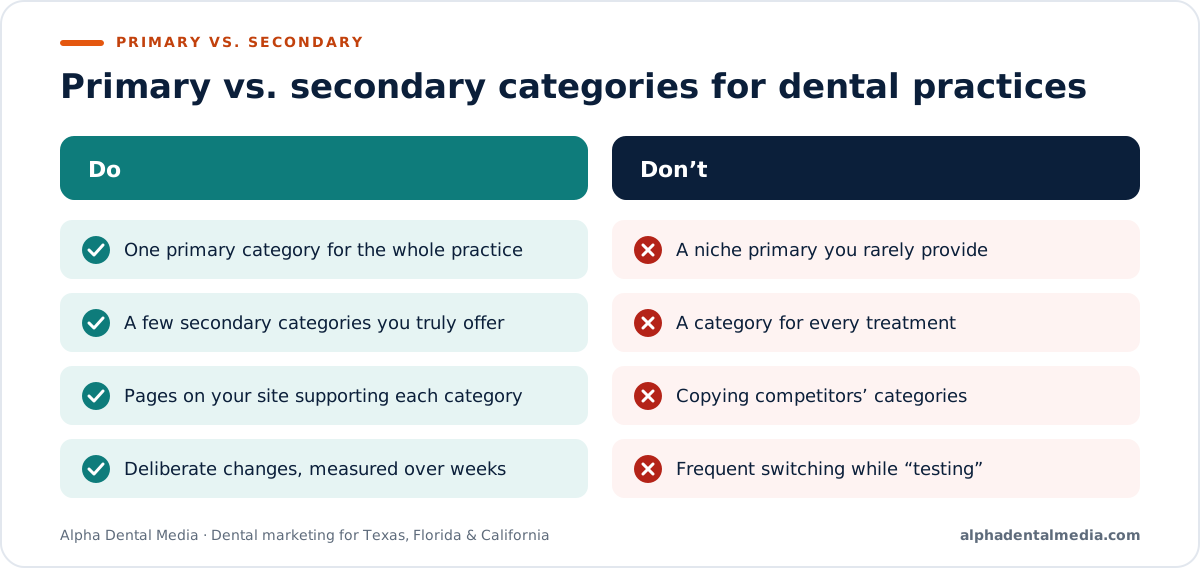
- Choose one primary category that best describes the practice as a whole.
- Add a few secondary categories only for services you genuinely and routinely provide.
- Google advises not selecting a category for every product or service.
- Category is a relevance signal — it works together with services, reviews and your website.
Your Google Business Profile category is one of the simplest settings in local SEO — and one of the most consequential. It tells Google what kind of practice you are, which searches you’re relevant for, and how to describe you to patients. A wrong primary category can keep an orthodontist out of “orthodontist near me” results; too many categories can blur a general practice’s relevance.
This guide explains how primary and secondary categories work, which choices fit common dental practice types, and what to watch for in competitive Texas, Florida and California markets.
How Categories Work
What is a Google Business Profile category?
A category tells Google and patients what your business is. Google asks you to select a primary category that best describes your business and lets you add additional categories. Categories help determine which searches your profile is relevant for and how it’s labeled in results.
What is the difference between primary and secondary categories?
The primary category describes the practice as a whole and carries the most weight. Secondary categories highlight additional, distinct services you genuinely provide. Google advises using a few categories from its list rather than one for every product or service.
| Primary category | Secondary categories | |
|---|---|---|
| Purpose | What the practice is | Distinct additional services |
| How many | Exactly one | A few, only where accurate |
| Example (general practice) | Dentist | Cosmetic dentist, Emergency dental service |
| Mistake to avoid | Choosing a niche you rarely provide | Adding every treatment as a category |
Do Google Business Profile categories affect map rankings?
Yes, as part of relevance. Google says local results are based mainly on relevance, distance and popularity. Accurate categories help Google match your profile to the right searches, but they work together with your services list, description, website content and reviews.
Choosing Categories by Practice Type
Which primary category should a general dentist choose?
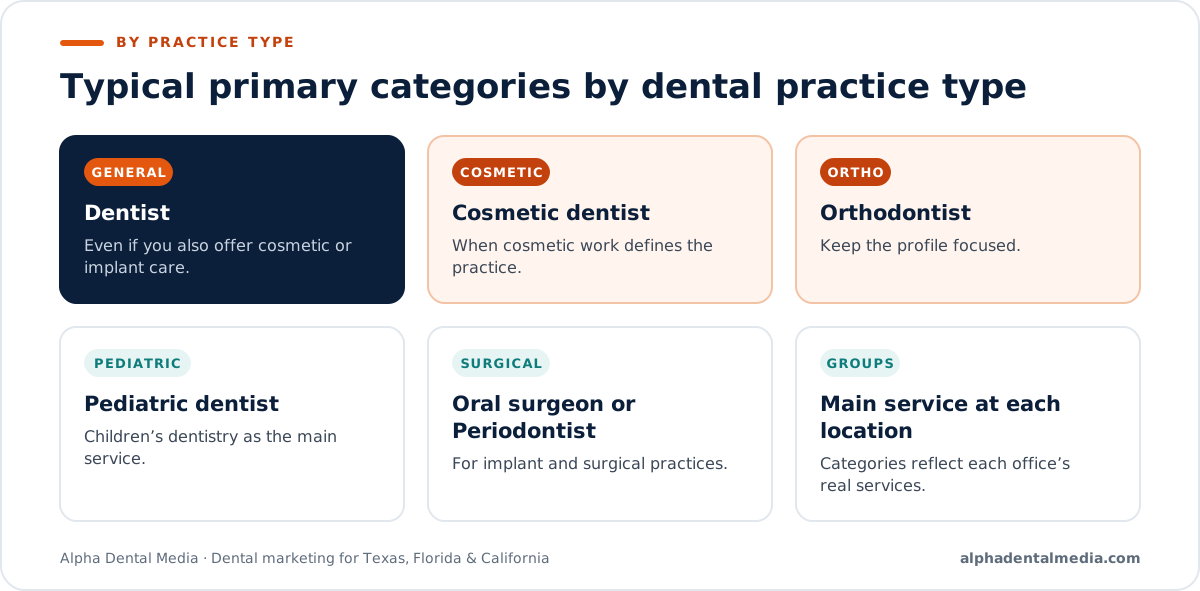
“Dentist” is usually the right primary category for a general or family practice, even if it also offers cosmetic, implant or emergency care. Add secondary categories only for services that are a genuine, routine part of the practice.
Which categories should specialty practices use?
Specialists should generally choose the category matching their specialty as primary, such as “Orthodontist,” “Pediatric dentist,” “Periodontist,” “Endodontist” or “Oral surgeon.” Make sure specialty descriptions also comply with your state dental board’s advertising rules.
| Practice type | Typical primary category | Possible secondary categories |
|---|---|---|
| General / family practice | Dentist | Cosmetic dentist, Emergency dental service |
| Cosmetic-focused practice | Cosmetic dentist | Dentist, Teeth whitening service |
| Orthodontic practice | Orthodontist | — (keep focused) |
| Pediatric practice | Pediatric dentist | — (keep focused) |
| Implant and surgical practice | Oral surgeon or Periodontist | Dentist (only if general care is offered) |
| Multi-specialty group | The main service at that location | Specialties actually provided there |
Category names change over time, so confirm the exact options in your profile editor.
Should a dentist add “Emergency dental service” as a category?
Only if you genuinely provide same-day or urgent care during your posted hours. If you add it, your hours, phone answering and website should support that promise; otherwise patients will be frustrated and you risk negative reviews.
How many categories should a dental practice use?
There’s no fixed number. Google advises not selecting a category for every product or service. Most practices are best served by one accurate primary category and a small number of genuinely relevant secondary ones.
Common Mistakes and Fixes
What are the most common category mistakes dentists make?
Choosing a niche primary category that doesn’t describe the whole practice, adding categories for every treatment, copying a competitor’s categories without offering those services, and changing categories frequently. Each can weaken relevance or confuse patients.
- Primary category describes the whole practice
- Secondary categories match services you routinely provide
- Services list includes each treatment with a description
- Website has pages supporting each category
- Changes made deliberately, then measured over weeks
Why did my dental profile’s category change on its own?
Google can apply edits it believes are more accurate, sometimes from user suggestions. Check your profile regularly, reject inaccurate edits, and make sure your website and listings clearly support your chosen categories.
Should categories be different for each office of a multi-location practice?
Yes, when the offices differ. Each location’s categories should reflect the services actually provided there. An office with an on-site orthodontist may warrant an orthodontic category; an office without one should not use it.
Categories in Texas, Florida and California
Do category strategies change in big metros?
The rules don’t change, but competition does. In crowded markets like Los Angeles, Miami and Houston, many practices share the same primary category, so supporting signals — services, reviews, location pages and languages — decide who stands out.
| Market | What to pair with accurate categories |
|---|---|
| Houston, Dallas–Fort Worth | Office-specific services and neighborhood pages |
| San Antonio, Miami, Los Angeles | Languages spoken and Spanish-language services descriptions |
| Orlando, Tampa | Accurate hours, especially if you list emergency care |
| Bay Area, San Diego, Sacramento | Detailed services and provider credentials |
Beyond Categories: Completing the Profile
What else should a dentist set up besides categories?
Categories are one part of relevance. Complete the services list, business description, attributes, hours, booking link, photos and Q&A. Each detail helps Google match your profile to the right searches and helps patients choose you.
| Profile section | What to add |
|---|---|
| Services | Every treatment you offer, with a plain-language description |
| Description | Who you serve, what you’re known for, where you are |
| Attributes | Accessibility, languages, online appointments |
| Hours | Regular, holiday and special hours |
| Photos | Exterior, entrance, reception, operatories, team |
| Booking link | Direct link to online scheduling |
How should dentists write their services list?
List each treatment you genuinely provide, using the names patients search for, and add a short, accurate description. Services complement categories: categories say what the practice is; services show the specific treatments you offer.
For example, a general practice might list cleanings and exams, fillings, crowns, root canals, implants, clear aligners, whitening and emergency care — each with one or two clear sentences.
Can the business description include keywords?
Write the description for patients: who you serve, what makes the practice distinctive and where you’re located. Natural mentions of your main services are fine, but stuffing it with keywords or city lists doesn’t help and makes it harder to read.
How do categories work with my website?
Your website should support each category with relevant content. If you list “Cosmetic dentist,” have a strong cosmetic dentistry page; if you list “Emergency dental service,” have an emergency page with clear hours and a phone number. Consistent signals reinforce relevance.
- A page exists for each category and major service
- Website hours match profile hours
- Profile links to the matching location page
- Structured data matches your name, address and phone
What profile mistakes undo good category choices?
Keyword-stuffed business names, inaccurate hours, an ineligible address, duplicate listings and unanswered reviews. These can lower trust or even lead to suspension, no matter how well categories are chosen.
Can I add a category for a service provided by a visiting specialist?
Only if the service is genuinely and regularly available at that location during your posted hours. If an oral surgeon visits once a month, describe that on your website and in your services list rather than making it a category that implies everyday availability.
How do categories affect which searches show my practice?
Categories help Google understand which searches your profile is relevant for, alongside your services, description, website and reviews. A pediatric category, for example, helps a profile appear for searches about children’s dentists, but strong supporting signals still decide how high it ranks.
That’s why category changes alone rarely transform rankings. They work best as part of a consistent profile and website that all describe the same practice in the same way.
Should a new practice test different categories?
Choose carefully at launch and avoid frequent changes. Constantly switching categories makes results hard to measure and can create confusion. Make a considered choice, support it with content, and give it several weeks before evaluating.
Document every change with its date so you can compare profile views, calls and direction requests before and after.
Do categories matter for multi-specialty dental groups?
Yes, and they need extra care. A group with general dentists, an orthodontist and an oral surgeon under one roof should choose the primary category that reflects the main service at that location, add secondary categories for the specialties genuinely offered there, and consider individual practitioner profiles where Google’s guidelines allow.
Each practitioner profile should describe that provider’s own specialty rather than duplicating the group’s full category list. Keep names, addresses and phone numbers consistent so Google understands how the profiles relate.
How do Google Business Profile posts and photos support categories?
Posts and photos reinforce what your categories claim. A cosmetic category is more convincing with photos of your cosmetic consultation room and posts about veneers or whitening; an emergency category is supported by posts about same-day availability. Keep both current and genuinely representative of the practice.
Practical habits that strengthen a profile over time:
- Add new photos regularly: exterior, entrance, team, operatories and technology
- Post updates about services, events and availability
- Answer common questions in the Q&A section where available
- Reply to every review using HIPAA-safe templates
- Review the profile monthly for edits suggested by other users
These activities don’t replace accurate categories, but they show Google and patients that the profile is active and that the services listed are real. A neglected profile with perfect categories often loses to an active one with good categories.
What to Expect
How long does it take to see results after changing categories?
Category changes can be reflected quickly, but ranking effects often take weeks to settle. Make one deliberate change at a time, record the date, and compare profile views, calls and direction requests before and after.
| Step | Timing | Action |
|---|---|---|
| Review | Day 1 | Audit current categories and services |
| Change | Day 1–2 | Update primary and secondary categories |
| Support | Weeks 1–2 | Align services list and website pages |
| Measure | Weeks 3–8 | Compare views, calls and direction requests |
The Bottom Line
Choose one accurate primary category, add only the few secondary categories you genuinely provide, and support every choice with services, photos, posts and website pages. Categories are a foundation for relevance, not a shortcut — consistent, active profiles that match the real practice are the ones that earn local visibility. Review your categories at least once a year, and whenever your services change.
Sources
- Google Business Profile Help — Choose a business category
- Google Business Profile Help — How to improve your local ranking on Google
- Google Business Profile Help — Guidelines for representing your business
Disclaimer: This article is for general educational purposes. Google’s categories and guidelines change, and local results vary by market and competition; no ranking outcome is guaranteed. Confirm specialty descriptions with your state dental board’s advertising rules and consult a qualified local SEO professional before major profile changes.